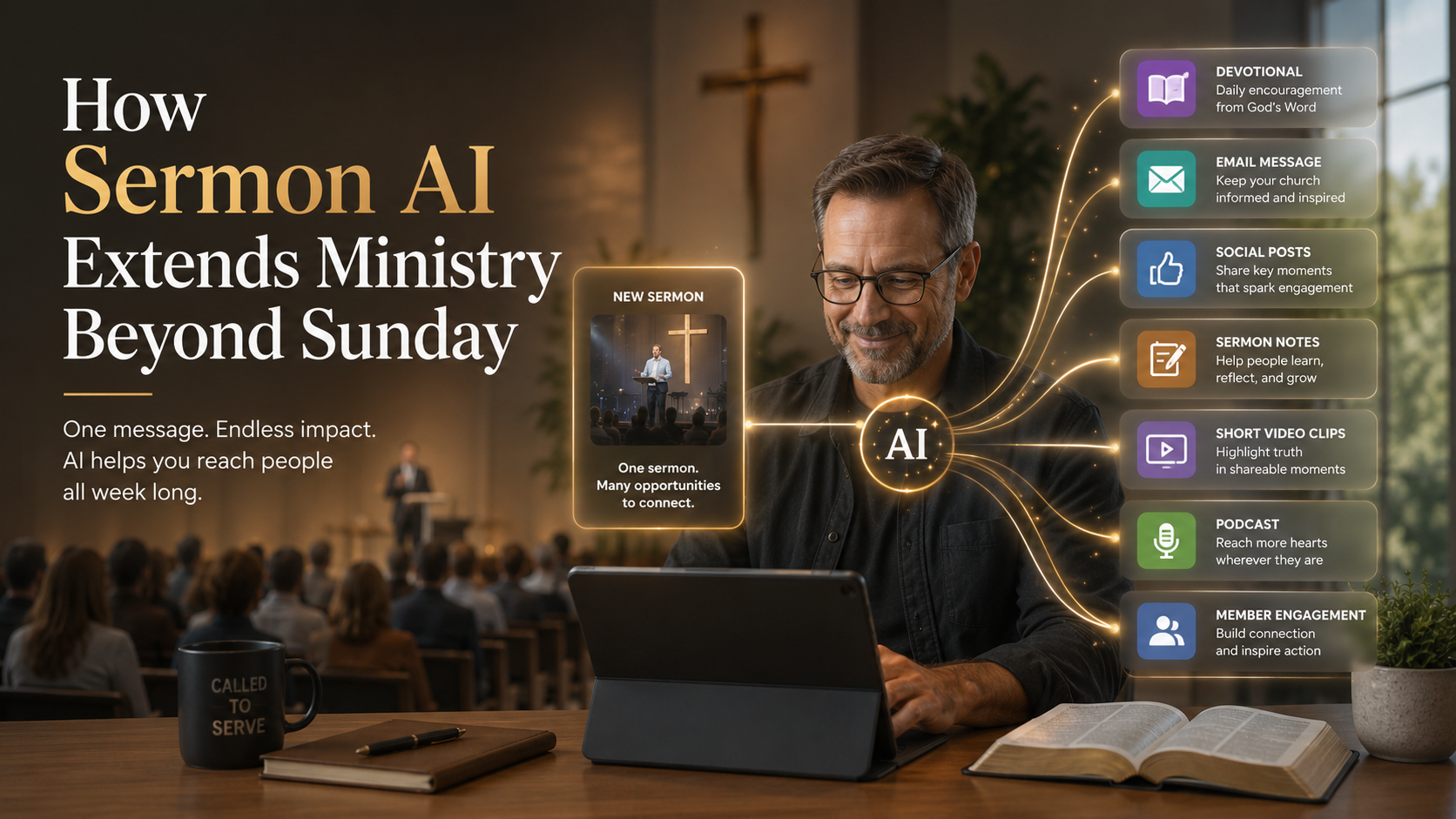
A sermon may take 15 hours to prepare and 35 minutes to preach. By Monday morning, many church teams face a familiar problem: the message that could guide the congregation all week is already competing with the next Sunday’s demands. Sermon AI gives churches a practical way to carry faithful preaching into weekday discipleship without adding another exhausting production cycle.
The goal is not to turn a pastor’s message into generic content. It is to help the church repeat, reinforce, and apply the truth it has already been given. When used with clear pastoral oversight, AI can turn one sermon into discussion material, social posts, slides, prayer prompts, and follow-up communication that keep the congregation connected to the message.
What Sermon AI Should Do for a Church
Church leaders do not need more content for content’s sake. They need a better way to steward the content they already create every week. A strong sermon AI workflow begins with the sermon transcript, notes, or recording and helps a team shape that material for the places people actually engage throughout the week.
For example, a Sunday message on forgiveness can become a small-group discussion guide for Wednesday, a short devotional reflection for Tuesday morning, a social post that highlights a key Scripture passage, and a prayer prompt that invites honest responses. Each asset should point back to the same biblical truth, not create a new theme simply to fill a channel.
That distinction matters. AI is fast, but ministry is relational. The technology can organize ideas, suggest formats, and reduce repetitive writing. It cannot discern the needs of a grieving family, interpret Scripture apart from responsible leadership, or replace the pastor’s calling to shepherd people. The right use of AI supports those responsibilities rather than competing with them.
A Weekly Workflow That Respects Your Team’s Time
The most effective approach is to make sermon content repurposing part of the church’s regular rhythm. It should not become a special project that only happens when the communications director has an unusually quiet week.
Start with the clearest source material available. A polished manuscript gives AI the most context, but a transcript, sermon outline, or detailed notes can also work well. Include the primary Scripture, sermon title, main points, audience context, and any language the pastor wants preserved. The better the input, the less time the team spends correcting output later.
From there, identify the ministry assets that serve your congregation best. A church with active groups may prioritize a discussion guide. A church working to reach younger families may focus more heavily on short social content and email reflections. A ministry with a strong prayer culture may create prompts that help people respond personally to the sermon’s central application.
The goal is consistency, not maximum volume. Three useful, well-reviewed pieces of content will generally do more for engagement than 15 posts that sound disconnected from the pulpit.
Keep the Sermon’s Voice Intact
A sermon has a voice, a theological framework, and a specific congregation in view. [AI-generated material](https://logoslink.io/blog/ai-tools-for-pastors) can lose all three when it is prompted too broadly. Asking for “five posts about hope” may produce acceptable copy, but it is unlikely to sound like your pastor or address what was actually preached.
A better instruction names the sermon’s main point and intended audience. For instance: create three social captions from this sermon on God’s faithfulness in suffering, using the pastor’s warm and direct tone. Keep each caption rooted in the primary passage, avoid promises Scripture does not make, and end with a simple reflection question.
That level of direction helps the tool produce a useful first draft. It also gives the reviewer a clear standard for approval.
Build Review Into the Process
Every sermon-derived asset should pass through human review before it reaches the congregation. This is especially true for Scripture references, theological claims, sensitive pastoral topics, and calls to action involving giving, prayer, counseling, or personal information.
Review does not have to erase the time savings. The communications team can check for clarity, accuracy, and tone while a pastor or designated ministry leader reviews theological alignment. For smaller teams, one trusted staff member may cover both roles. What matters is that AI is treated as an assistant, not an autonomous ministry voice.
Where Sermon AI Creates the Most Value
Study guides are one of the strongest uses because they move a sermon from passive listening to active conversation. A guide can include the main passage, a brief recap, several observation questions, application prompts, and a closing prayer. It gives group leaders a reliable starting point while leaving room for real discussion.
Social content is another natural fit, particularly when it is built around memorable phrases, Scripture, and concrete application. Rather than posting a generic inspirational quote, use content that reminds people what they heard and invites them to practice it. A short post on Monday can reinforce the message. A reflection question on Thursday can prepare hearts for weekend worship.
Slides can also extend a message when they are designed for church announcements, group gatherings, or sermon recap moments. Simple visual prompts help people retain the central idea, especially when paired with a clear next step.
Prayer engagement deserves special attention. If a sermon addresses anxiety, grief, marriage, or repentance, people may be ready to ask for prayer but unsure where to begin. A carefully worded prompt can create a bridge between preaching and pastoral care. Church teams should establish clear response practices so [submitted requests](https://logoslink.io/blog/best-prayer-team-software-2026) are organized, assigned appropriately, and handled with discretion.
The Risks Churches Should Plan For
Sermon AI can save time, but it can also create problems when speed becomes the only measure of success. One risk is theological flattening. AI tends to favor familiar, broadly acceptable language unless the church provides enough context. That can turn a specific biblical message into vague encouragement.
Another risk is overproduction. If every sermon becomes dozens of assets, the congregation may experience content fatigue. The point is not to surround people with church messaging. It is to offer timely reminders and meaningful opportunities to respond.
Privacy is equally significant. Do not place confidential counseling details, private prayer requests, donor data, or identifiable pastoral conversations into public AI tools. Churches should have clear internal guidelines for what content can be used, who can access it, and where final materials are stored.
Finally, consider ownership and brand consistency. A church’s content should remain connected to its teaching, mission, and visual identity. Disconnected tools often create scattered files, duplicate subscriptions, inconsistent language, and uncertainty over who owns the next step.
Why an Integrated Church Platform Matters
Sermon content works best when it does not live in isolation. A study guide should be easy for group leaders to find. A social post should connect naturally to the church’s broader communication rhythm. A prayer prompt should lead into a secure, organized way for people to share needs. [Giving communication](https://logoslink.io/blog/grow-online-giving-2026) should be transparent, respectful, and consistent with the church’s stewardship values.
That is why a church-specific system can be more useful than a collection of unrelated AI, design, email, giving, and prayer tools. LogosLink helps teams turn sermons into ministry assets while keeping communication, generosity, and congregational care connected in one branded environment. For mid-size churches, this can reduce the administrative friction that keeps staff focused on software instead of people.
Integration is not automatically the right answer for every church. A ministry with a deeply established technology stack may choose to keep specialized tools. But when staff members are repeatedly moving content, donor records, and prayer requests between systems, the cost is more than subscription fees. It is lost time, slower follow-up, and fewer opportunities for meaningful connection.
Start With One Sermon and One Clear Outcome
The best first step is not a major content overhaul. Choose one upcoming sermon and one outcome you want to improve. You may want more group participation, a stronger midweek social presence, or a more visible prayer response path. Create only the assets needed to support that outcome, review them carefully, and watch how people respond.
Then refine the process. Notice which prompts produce material that sounds like your church. Pay attention to what group leaders use, what posts earn thoughtful engagement, and where people ask for prayer or next steps. Over time, sermon AI becomes less about generating more material and more about creating a dependable rhythm of reinforcement and care.
A faithful sermon should not have to disappear after the closing prayer. With wise processes and human leadership, the message can remain present in the conversations, questions, prayers, and decisions that shape the rest of the week.